
When our Founders drafted the Constitution, they intended that Congress would keep the judiciary as the “least powerful” branch of government and see to it that judges “should be bound down by strict rules and precedents, which serve to define and point out their duty.” (as Alexander Hamilton wrote in Federalist
78).
Accordingly, the Constitution in Article I, Section 8, states: “The Congress shall have power . . . to constitute tribunals inferior to the Supreme Court.” Article III, Section 1, states: “The judicial power of the United States, shall be vested in one Supreme Court, and in such inferior courts as the Congress may from time to time ordain and establish.” In summary, all federal courts except the Supreme Court were created by Congress, which defined their powers and prescribed what kind of cases they can hear. Going a step further, Article III, Section 2, states: “the Supreme Court shall have appellate jurisdiction, both as to law and fact, with such exceptions, and under such regulations as the Congress shall make.” In summary, Congress can make “exceptions” to the types of cases that the Supreme Court can decide.
Phyllis Schlafly’s book The Supremacists shows there is a long historical record where Congress has used this power repeatedly to regulate and limit both Supreme Court and inferior court’s jurisdiction starting in 1799 to 1999—and discusses how today activist judges are refusing to restrain themselves to their constitutional role and provides recommendations for correction.
Schlafly points out the judicial misconduct taking place all over the country where federal judges have declared that the display of the Ten Commandments in public schools or public buildings are unconstitutional “under the pretense that any mention of God violates the First Amendment, which states: “Congress shall make no law respecting an establishment of religion, or prohibiting the free exercise thereof.” Importantly, she states “the acknowledgement of God in the Ten Commandments is not an ‘establishment of religion’, and that Congress has never passed a law banning the acknowledgement of God.”
Schlafly recommends that “Congress should pass a law to clarify that the federal courts and Supreme Court do NOT have jurisdiction over whether an acknowledgement of God by public officials violate the Establishment Clause of the First Amendment—and that Congress forbids federal courts from censoring public acknowledgement of God.”
The time for Congress to act is now. In 2022 the Supreme Court ruled that the flawed Lemon v. Kurtzman test for the acknowledgement of God, which had falsely interpreted that the First Amendment prohibits the mention of God in any public place, will no longer be applied.
Now Congress needs to finish the job using its Constitutional powers over the judiciary.
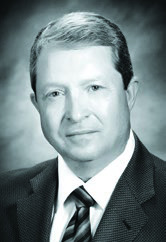
Steve Gardes is a Certifi ed Public Accountant (CPA) and Certified Valuation Analyst (CVA) with over 40 years of public accounting experience.